of wood and warblers : musings on my upcoming 3rd spring migration season as a birder in Nova Scotia

Atlantic Canada, BEYOND, Birds, Canada

Warblers are among the highest prized things with wings for the avid birder.  And they call them wood-warblers for a reason.

I’ll be heading into my 3rd migration season as a birder with a bit of a heavy heart as I’ve recently become aware of the full extent of the clearcutting that is happening in Nova Scotia.

As well that a 13-mill consortium called Westfor has their eye on the Western Crown Lands which have been described  as “the last great wood basket” not committed to pulp companies, which will effectively destroy the last of our forests here in the province.

To enjoy spring migration to the fullest, brushing up is always recommended.  So, partially to encourage some discussion about the preservation of mixed, multi-aged forest in Nova Scotia, and partly as a little research project for myself to prepare I spent much of today studying the breeding habitat of Nova Scotia wood-warblers.

Of the 40 Wood Warblers that have been recorded in Nova Scotia, 22 of them breed here both currently and historically.  Two have been added to the list recently but one (Yellow-breasted Chat) was certainly incidental and the other (Pine Warbler) could be the beginning of an expansion of breeding territory to come in future years.

My lifelong love of walking in the woods, and back-country canoe camping in recent years, have proven to be a great foundation for studying our wood-warblers first hand.  While writing this today I realized that I’ve observed a great deal of warbler behavior and habitat in my two short years of birding.  And I’ve had some amazing mentors in these two years, I must admit and am so thankful for your guidance (you all know who you are and you are awesome).

There is still much to learn (this is a living work and I’m definitely at the beginning end of things) so I’ve referenced the following materials extensively today:

to compile the little spreadsheet below at the end of this post.

Someday I hope to write a book at which point I’ll work on more detailed citations, but for today I had time to write a blog in hopes it will inspire a few people to dig deeper into this issue.  Emails with corrections are always welcome and appreciated!

Anyway, basically our beloved wood-warblers drop in during spring migration, disperse into appropriate habitat, breed, and then flock off in the fall migration.

The NSBS hosted a presentation by Donna Crossland last Thursday evening  where I learned there is not much left of less than 1% of our old growth Acadian Forest left (it was about 50% in pre-Colombian times, and 15% in the 1950s) and even the remaining younger, multi-aged  (not clear-cut) Acadian forest is in grave danger.

Most of Nova Scotia’s working forest is clear cut.  We are on a 55-year cut cycle, far too short to maintain the Acadian forest which should be selectively harvested (not clear-cut), and trees such as red spruce, hemlock, and sugar maple allowed to grow to 150 years of age (or more).  The Nova Scotia government promised to reduce clear-cutting, and has done no such thing.

(thank you David Patriquin for the clarification of our forest compositions)

Aside from soil erosion leading to potential coastline erosion, and the release of carbon into the environment (remember plants remove carbon dioxide from the environment into the soil) imagine the horror for the birds and other animals who lose their homes, and inevitably perish.

Basically, if we keep chopping down their homes they will have nowhere to breed.  They are increasingly showing up to find their habitat and food had been destroyed which is a problem for both the present and the future.  My focus here is on the wood-warblers but many other bird species require the very specific habitat of the Acadian Forest such at the Black-backed Woodpecker, and the Nothern Goshawk to name just two.

Anyway, as I reflect on my last two years in birding I am reminded that you have to do a bit of work to find some of the most prized wood-warblers.  Well it’s not work for me at all to walk in the woods, but it’s something not many people seem interested in doing these days somehow.  All my favorite magical forests are old-growth forests and largely Acadian it would turn out, with Keji being one of my most treasured places to spend time.  I’ve also greatly enjoyed walking in the Thomas Raddall provincial park, the Abraham Lake Nature Preserve, the Mount Uniacke Estate park, the Herbert River Trail, and the woods around my parents’ house just to name a few.

I remember looking up so high in the trees to spot the singing Blackburnian Warbler in Mount Uniacke Estates park and realizing this now scarce habitat explains why they are not always easy to find in Nova Scotia.

Blackburnian Warbler (new to me today) June 1st, 2016 Mount Uniacke Estate Park

It occurs to me now why many of the seasoned birders frequently comment there are “no birds anymore”.  Migration season used to be a very different experience here in Nova Scotia apparently.  And that is very sad isn’t it?

Someone needs to do something and I agree with Donna Crossland who suggests the birders are the perfect people to spearhead the cause.

Simply put, clear-cutting is short sighted and harmful to wildlife.  We deserve a sustainable forestry industry in Nova Scotia that is guided by good science and education, and stewarded by forestry experts, not lumber executives.  And now that I know we are sending all this biomass to China and Turkey I am steaming mad.  We are chopping down all our forests for a cheap buck and sending it away in little wood chips.  Nothing to be proud of, indeed.

I don’t know much about the South Shore forests, but I do know the “banana belt” hosts some of the best birding opportunities in Nova Scotia and the birders down there are hopefully ready to chase Westfor right out of town.  I’ve not done the warbler run in Yarmouth but I’ll bet that strip on Thomas Road and Jerry Road is all old-growth forest, and it’s probably on the chopping block (literally). (I have found out since I posted this from Alix d’Entremont that the area I mention in Cape Forchu is not old-growth in fact but the Quinan and Great Barren Lakes Reserve and also Sporting Lake are likely the last stands of old-growth forest in South Western Nova Scotia.)

As a little aside, maybe we only hear of protecting the Boreal Forest because the Acadian Forest is pretty much already gone?

I digress, but basically we have two types of wood-warblers that visit Nova Scotia.  We have the “vagrants” who don’t belong here really, and certainly don’t breed here.  They are the ones who have us scanning multi-flora behind funeral homes and other odd places during migrations or fall outs, and making the non-birders wonder what the heck we are doing.  Then we have those 22 warblers who come to Nova Scotia specifically to make babies and fly off with them in the fall.  They go in two waves, the parents and new birdies typically not together.  It is a joy or nature everyone should witness so please consider getting involved and engaged with this issue.  In my opinion land conservation and activism is one of the best places you can donate your money or your time in our province.

I smile as a remember some of my favorite birding moments have involved fledgling birds, specifically warblers.

Anyway, look through the list for yourself and decide what you think is worth protecting.  And remember, these are the canaries of our proverbial coal mines because if they are in danger, so are we…

“I’m like a bird, I’ll only fly away I don’t know where my soul is, I don’t know where my home is” – Nelly Furtado

Wood Warbler Breeds in NS historically Breeds in NS currently Prerred Vegetation
American Redstart yes yes alders tall shrubland garden shrubbery
Bay-breasted Warbler yes yes (in decline) tall conifers
Black-and-white Warbler yes yes broad leafed and mixed woodlands
Blackburnian Warbler yes yes tall conifers
Blackpoll Warbler yes yes cool, damp spruce
Black-throated Blue Warbler yes yes broad leafed mature woodland stands
Black-throated Gray Warbler NO no
Black-throated Green Warbler yes yes mature mixed but also broken fir and spruce
Blue-winged Warbler NO no
Canada Warbler yes yes broad leafed trees / shrubs / dense understory
Cape May Warbler yes yes (in decline) tall Spruce
Cerulean Warbler NO no
Chestnut-sided Warbler yes yes shrubs / raspberry / forest edge
Common Yellowthroat yes yes scrubby brush / cutover / marsh
Connecticut Warbler NO no
Golden-winged Warbler no no
Hermit Warbler no no
Hooded Warbler NO no
Kentucky Warbler no no
Louisiana Waterthrush no no
Magnolia Warbler yes yes open woodlands / balsam fir
Mourning Warbler yes yes dense deciduous shrubbery woodland edges
Nashville Warbler yes yes open woodlands and shrublands
Northern Parula yes yes mature forests uses old man’s beard for nests
Northern Waterthrush yes yes damp mixed woodlands alder and cedar
Orange-crowned Warbler no no
Ovenbird yes yes Blue-bead Lily under the Broad-leafed trees
Palm Warbler yes yes low conifers / bog / shrubs
Pine Warbler no (NB yes) one nesting in Truro 2010 recorded in the 2nd breeding atlas – also thought to be breeding in Miller Point Peace Park in Bridgewater and in Oafield Park near Enfield for a few years now pine
Prairie Warbler no no
Prothonotary Warbler no no
Swainson’s Warbler NO no
Tennessee Warbler yes yes (in decline) spruce/fir for the budworm
Virginia’s Warbler no no
Wilson’s Warbler yes yes shrubland early forest succession
Worm-eating Warbler no no
Yellow Warbler yes yes urban gardens / shrubbery / old fields / streams / marshes
Yellow-breasted Chat no 1 probable” record in NS during the second atlas dense shrubbery with a preference for blackberry
Yellow-rumped Warbler yes yes dense spruce cover and bayberry for food (wax myrtle)

dialing it back : in pursuit of simpler birding goals and serendipity

BEYOND, Birds
img_5769-scaled

Macy saying “what do you mean there is not one Green-winged Teal in Miner’s Marsh today ma?”

There is an elephant in the room.  Admittedly lots of birders talk about it but in secret, but it’s a shame that nobody ever tackles it collectively or takes a strong position stance as it presents a very worthy topic for discussion and learning opportunities.

Increasingly modern birders are including playback and mob calls in their digital toolkits.  “Fundamentally, birding disturbs birds.” – David Sibley has addressed the issue of playback very well here.  The mob call is not mentioned in this article, which is very different and being used more widely locally.

After birding for the better part of two years now and being privileged enough to bird with most of the top birders in the province, I’ve been exposed to all kinds of birding philosophies and techniques.  I will say I trust the judgement and personal choices of experience birders so I’m not taking a poke at any of you, I’d tell you if I were  🙂

From day one I’ve had my own ideas about it though.  At an early age, I learned that picking up the frogs and salamanders and taking them home for pets led to disaster not only from an angry mother, but the animals often died.  As adults, we should know that our strong desire to connect with nature needs to be tempered with respect for the wild kingdom.

Most of us birders are guilty of “disturbing birds”.  We can’t seem to help ourselves trying to get closer for the great shot and justifying seemingly harmless methods to get the edge.  The lines between birder, bird photographer, and naturalist blur repeatedly in the field and among friends.  We push the envelope largely to get that National Geographic worthy shot.

I’ve retreated a bit from birding recently as I fell into the twitching trap and chased some Western vagrant birds around.  I always feel sorry for the birds (yes I heard the Yellow-billed Cuckoo was simply drunk on berries…LOL) when we do this but the temptation is so great to check lifers off the list.

Don’t get me wrong, the good majority of local birders are very concerned about the future of birds and wish to do no harm.  But there is a contingent of newbies who have no idea of the consequence of their actions who could benefit from guidance in field practices.  Where does the line get crossed?  I believe if the bird is stressed or frightened or disrupted from it’s usual behavior then we have gone too far, and we know it and it sucks.  Truly I think this is a discussion worthy topic.

Based on what I have learned and my early life experiences, I personally believe there is a case for limited use of mob calls or playback in the field for documenting species and locations depending on the circumstances and time of year.  But surely having a lot of people blasting sounds indiscriminately at the birds (who already have enough problems from development, window strikes, climate change, cat predation, etc.) is not the best judgement.

It was an extremely exciting migration season here in Nova Scotia and it’s difficult to get any looks at the rarities without chasing them.  I get it.  I do it.  I am just asking that we all (myself included) continue to check our conscience and if you don’t know what I am talking about at all make it a point to speak with a birder who has been observing birds in the field for many years for a balanced point of view.  The less invasive we can be the better it will be for our fine feathered friends that we love so dearly.

Walking quietly has always netted the best birding results for me.  My new canine pal Macy is a fine companion in the field when she’s on leash.  We have sat quietly together and waited for the birds to come to us and I’ve gotten some great photos.  Admittedly sometimes she ruins the photos but she is “in training” and we have many years ahead to improve.

Most of the best wildlife and birding photographers stress that you will get better looks at the critters if you wait until they come to you instead of chasing them.  Interesting as well that some of the best birders only carry binoculars and a notepad.  The world before digital was not that long ago and we should not lose our core birding skills in the frenzy of nabbing the best photos.

As for twitching, I’ve heard a few people say “imagine what we are missing?”.  If you are out chasing other people’s birds, you will miss the opportunity to find your own.  And that first sighting the initial observer had, well it only comes once and they got it.

Everyone will do their own thing and I respect that and enjoy the company of all my friends here in our wonderful birding community.  For me, I will continue to focus on learning about habitat and microhabitat (which is key for finding vagrants).  Next Spring and Fall I’m going to try to cover more territory to find my own birds, probably with my good friend Macy in tow although there are times she needs to sit it out for sure.

There are many native birds I’ve yet to check off my list.  So, that should keep me busy this winter.  Black-backed Woodpecker and Northern Goshawk are just two that have eluded me so far that I’d like to get good looks at, and perhaps a nice photo of course.

So, dialing it back.  I’m also resetting my immediate goals to try to get better photos of repeat species.  I have no decent photos of a Horned Grebe or Green-winged Teal for example.  Both relatively common but beautiful subjects worthy of more attention.

Anyway, this has been on my mind to bring up for a long time but it’s an extremely controversial topic which can heat up conversations quickly.  Perhaps better for pondering.  And if you decided to speak to me about it at the AGM, perhaps see how many glasses of wine I’ve had first?

Seriously, we have an amazing birding community I will step off the soapbox now and look forward to continuing to spend time with all our good folk.

What are your winter birding goals btw?

Happy Birding,

Angela & Macy (bird dog in training)

fall migration a time of jealousy, nemesis birds, and natural wonders (aka those elusive Godwits!)

Atlantic Canada, BEYOND, Birds, Canada

I don’t have as much budget for petrol as many of my birding friends, however I live near a migratory point (Hartlen Point), and so do my parents in Cape Breton (short driving distance to Donkin).  And so although I cannot visit the banana belt (CSI) as often as I would like, I still make out like a bandit and am getting my share of great birds for sure.

It is the time of the year to be jealous of all your bird friends and they of you, and to want to be in several places at one time.  While visiting Cape Breton this week I frequently wished I were back in Eastern Passage, and some of my friends wished they were here.  And so it goes during fall migration!

Alas, my two present targets have eluded me and one my current nemesis at that.  The Hudsonian Godwits escaped me in Cape Sable Island a few weeks ago, and now I’ve missed them on 3 separate attempts this week in the Morien to Glace Bay region.  Last year I didn’t get my Buff-breasted Sandpipers either and it looks like I will miss them at Donkin as I only have one tropically windy day left on the island.

Although Saturday I intend to bird through the Framboise/Forchu area (thank you for this tip and ongoing Cape Breton inspiration David McCorquodale) and up to Point Michaud before returning to the Halifax area.  Shorebird season is short and exciting so even if I miss my targets it is all to be enjoyed to the fullest.

Cape Breton birds are ridiculously under-documented.  And there are tons of great birding experiences to be had on this island.  Many very knowledgeable birders have lots of local knowledge to share should anyone want to sit them down and record it before it is lost.  Like most things the world seems to stop at the causeway.  I hope more inroads will be built to connect the birders and in particular I would like to see representation on the board again from Cape Breton to the NSBS.  Skype and Facechat are wonderful technologies that are one way to bridge the gap of distance.  As a Cape Bretoner who is now a mainlander this has always been something I’ve tried to tackle in various organizations.  It would be really cool too if someone could get a student to put some historical records from some of these fantastic birders handwritten records and heavily notated field guides into the eBird database even.  Okay stepping off my soapbox now and on to the wonderful birds here on the island and a thank you to the good folk who have made, are are still making such efforts past and present.  Ian McLaren for certain!

Shorebirding in the Cape Breton and Richmond counties is pretty amazing and for me it’s nice to see birds in good numbers that I don’t see more than a few of at home, such as these Ruddy Turnstones.

There is so much coastline that is easily accessible and where there are people they are easy going and friendly and engaged with nature for the most part.  I have had a great time walking with my dog on leash who has met other friendly dogs and met people who have lived here all their life, moved here from away, or are just visiting all with varying knowledge of birds and all interested in learning a little more.

I do hope the island never gets over developed and keeps rich in habitat and attracts visitors who appreciate nature and a slower pace of life.

So all this being said, on my hunt for shorebird rarities (have not even spotted a Bairds yet) I have been striking out for the most part but did find 3 rare non-shorebirds today that were completely unexpected and self found.  And one a lifer to boot!

In Lingan today I found a juvenile Little Blue Heron in a small pond with two Lark Sparrows flitting about in the same spot.

IMG_7260-scaled

juvenile Little Blue Heron – Lingan, CB, NS September 1st, 2016

Lark Sparrow - Sept. 1, 2016 Lingan - Cape Breton - NS - proudly photographed with my crazy Border Collie on leash

Lark Sparrow (one of two seen) Lingan, CB, NS September 1st, 2016


And then when I did my last unsuccessful scout at Schooner Pond for Buff-breasteds I happened upon a group of sparrows making a call I did not recognize.  I noticed they were sort of dark capped and had smooth unstreaked breasts.  I tried to snap some evidence as they quickly made their way through the bushes into the marsh not to be seen again mixed in with goldfinch and songs.  And good thing I’m a quick snapper because my little friend with the bright pink beak turns out to be a Clay-coloured Sparrow.  The photo is horrendous but I cropped it out here so you can at least get the ID if you are a birder who is interested in that type of thing.

IMG_7410-crop

Clay-coloured Sparrow – Sept. 1st Schooner Pond, Donkin, CB, NS

Worthy of note is the large number of Great Blue Herons in the area.  Particularly in Port Morien where I counted a minimum of 39 in one view two days ago and certainly there were many more.

Mostly I’ve just enjoyed the birds in some places that are recently discovered for me as birding really encourages you to get to know your own homeland inside and out.  Today was in fact my first visit to Dominion Beach if you can believe it and Macy and I had a lovely walk on the boardwalk checking for shorebirds.

IMG_7315-crop

spacey Macy at Dominion Beach

IMG_7367-scaled

Macy my fine birding companion in training at Dominion Beach

Here is a little collection of my favorite sightings from the past few days.  Nothing too spectacular, but I think all of us nature lovers appreciate the fact that the shorebirds don’t visit for long and it is a natural wonder to be savoured.

Happy Fall Migration,

Angela & Macy (bird dog in training)

what it's like to bird with an on leash dog - do you see the Ruddy Turnstones beyond those ears?

what it’s like to bird with an on leash dog – do you see the Ruddy Turnstones beyond those ears?


the best of company from land and sea – Pubnico Pelagic on the German Bank August 13th 2016

BEYOND, Birds

If you know me you also know that rising early goes against my grain, but when presented with the opportunity to spend time in Mother Nature’s open university for the day I typically rise to the occasion.  In this floating classroom I was surrounded by esteemed colleagues I hold in very high regard, and to steal a term from a birding friend I must say openly that I was extremely chuffed to be included.

IMG_4122

a reason to get up early for sure – sun coming up not far from shore West Pubnico

angie-crop

thank you Diane for catching me when I was not looking!

Hats off to Ronnie d’Entremont for organizing an amazing adventure for us and being a wonderful host for this West Pubnico Pelagic trip.  Also a warm thank you to our captain for your skill in keeping us safe on the seas.  Your community is filled with beauty and generosity so happy to be a part of this day.

Also thank you to my kind hosts Mark and Sandra Dennis for wonderful hospitality and company on Friday evening, and my excellent traveling companion for the weekend, Diane Leblanc.

When Diane and I showed up at the Dennis residence on Friday, we immediately followed a twitch which didn’t work out but was a grand adventure nonetheless.  We were entertained by some lovely butterflies which is often as worthy a pursuit of winged things, as well as a nice show of shorebirds in living color, so no crying over spilt milk for us.

IMG_3996

Silver-bordered Frittilary butterfly

IMG_4028

Least Sandpiper in yellow algae bloom

Later on my target bird for the land portion of my adventure, the Hudsonian Godwit, eluded me but I did get lesson on another lifer bird, Roseate Tern, by Mark which was illustrated wonderfully by a group of Common and Roseate Terns.

Liz Voellinger & Diane LeBlanc at the Hawk Beach (Mark and I stalking a Northern Harrier in the back)

Liz Voellinger & Diane LeBlanc at the Hawk Beach (Mark and I stalking a Northern Harrier in the back)

Mark making an attempt to summon the Godwits for us - the birds were having none of it as they think we should back in early September to see them and also their little friends, the Buff-breasted Sandpiper - and so it will likely be...

Mark making an attempt to summon the Godwits for us – the birds were having none of it as they think we should come back in early September to see them and also their little friends, the Buff-breasted Sandpiper – and so it will likely be…

Birding for Friday had to wrap up early as we had to rise by 345am to make it in time for the boat on Saturday morn.

Not often am I at a loss for words but I find myself slightly verklempt and at that the remainder of this post will be mostly dedicated to photos.

All the pelagics were new to me save the Northern Gannet and Black-legged Kittiwake and I stacked up 8 lifers on this trip.

My photos are not star quality for sure but I am limited by my bridge camera, but also able to at least get the shot.  Practice makes perfect and I will earn that DSLR I dream of in the not too far off future, I promise.  There will be photos from this trip from other participants that will definitely qualify as star quality.  Thank you to them for continually raising the bar and capturing beautiful things so skillfully.

Our bird of the day was a Manx Shearwater who put on a stellar performance and ended an already great day with perfection.

Definitely one of the best days of my life this far.  And I’m on a mission to top them every day!

Happy birding and serendipity to you,

Angela

IMG_4322

unaltered surprise photo nuttiness 2 Great Shearwaters and a scallop boat

IMG_4455

Great Shearwater

IMG_4457

Great Shearwater

IMG_4492

Wilson’s Storm Petrel

IMG_4544

had really hoped but Leach’s and Wilson’s Storm Petrels were in this shot as we saw both but I’m 99% sure now they are both Wilson’s

IMG_4563

Wilson’s Storm Petrel teeny far away subject

IMG_4588

Great Shearwater

IMG_4590

Great Shearwaters

IMG_4601

Great Shearwater

IMG_4618

Wilson’s Storm Petrel and Great Shearwater

IMG_4604

Wilson’s Storm Petrel

IMG_4625

Great Shearwater

IMG_4636

Great Shearwater spitting out the chum apparently they don’t like liver!

IMG_4661

Wilson’s Storm Petrel

IMG_4686

my first Lesser Black-backed Gull – NOT a pelagic but still wonderful serendipity

IMG_4689

Wilsons Storm Petrel

IMG_4694

Manx Shearwater and gull competing for chum

IMG_4707

Manx Shearwater

what are the birds doing? of habits and habitat

BEYOND, Birds

I’ve been birding here and there for the past 3 months since I’ve adopted the Border Collie but not blogging too much so here is a long and windy post.  Since this is my second summer birding, I am more keen to learn the songs and sounds of birds.  And most of all habits and habitat.

It is all well and good to “twitch” birds that have already been found by others, but to find them on your own you need to become familiar with the habits and habitat of birds.

This holds true for both native species and vagrants, who are the delight of every birder.  I am at the beginning of this process and expect to spend many years of study before I get a handle on it but the first lesson that stands out in my mind is about the Ovenbird.  These birds are uncommon and local which means they are not common all over, but in the right habitat there are pockets of them.  When I visited my parents this summer in Sydney I realized they are all over the woods surrounding our house.  And somehow in my ongoing education by Google, I found out they build their nests using Blue-bead Lily plants.  I played in the woods pretty much every day as a child and vividly remember the ground being covered by these plants so it all makes perfect sense now.  Knowing this now I will always recognize their habitat.  And so I am hooked.  If I can learn this for all our native species I should always know when to keep my eyes peeled for them.

My goal is to categorize this information in a logical way over time.  Native birds, diet, vegetation, etc. organized in a way that has not yet been done.  If there is currently a Nova Scotia book that does just this, please let me know.  I understand the breeding atlas contains a lot of this information but I don’t have my copy yet.  Keeping notes has always been my way to learn though so this will be a worthwhile project for me either way, and is a large reason for my keeping this blog.

Since my last blog I’ve visited some great spots and my accounts will not be detailed but here are the highlights.  The photos are doc shots, not great photos but “evidence” as my friend Paul says.

Paul and his dog and me and Macy (dogs on-leash) spent a few hours exploring the Belleisle Marsh.  Gem of a place where we were treated to the songs of at least 3 Soras, and even got a little show from one.

IMG_9646

Sora (a type of super skulky rail with a really cool song…google it!)

Shorebird season is upon us, and although I’ve not been able to get to the banana belt yet (CSI), Eastern Shore shorebirding is very good.  On my own I located 2 Pectoral Sandpipers in Three Fathom Harbour which was very cool as they were a lifer for me.
Pectoral Sandpiper - Three Fathom Harbour July 19, 2016

A little group of us had a lovely day trip to Johnson Mills in NB to watch the “shorebird ballet” and made a stop in Amherst to see the Black Terns that hang out on the Amherst Marsh in summer.  Another lifer for me which was a bonus in an already wonderful day.

Semipalmated Sandpipers there were about 30K of them there my pictures do not do this justice you just have to go it's amazing!

Semipalmated Sandpipers there were about 30K of them there my pictures do not do this justice you just have to go it’s amazing!

Just a doc shot but happy to finally see my first Black Terns today - this one carrying a fish - Amherst Marsh (as promised) July 28, 2016
Closer to home, Hartlen Point is starting to heat up again.  The Whimbrels have been hanging around for a while now and other shorebirds are collecting up in the evenings before they head off to sleep somewhere.  McNab’s Island perhaps?  As a result the Merlin are perched on the shore waiting for snacking opportunities most evenings.
Whimbrel - hard to get close to so not very sharp - Hartlen Point - July 13, 2016

Merlin hunting the shore

Merlin hunting the shore

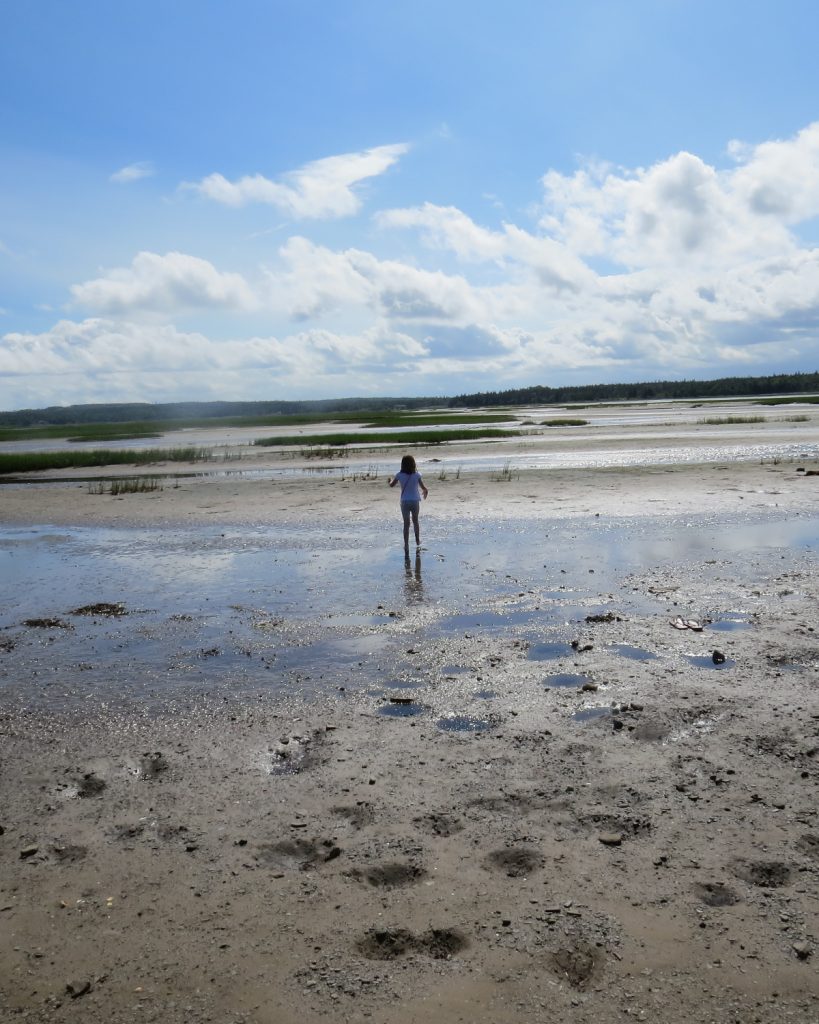
Last week I spent a few days in Sydney visiting family and also working in pet shops and I had a low tide adventure with my 7 year old niece and Macy at Morien Bar.  This is one of the best shorebird spots in Nova Scotia and the only thing that would have made the experience better would be a scope.  Still we saw lots of Yellowlegs, Dowitchers, and Semipalmated Sandpipers with a few Whimbrel and Black-bellied Plovers mixed in for good measure.  I wish I would be there this week as it’s time for the Hudsonian Godwit to show up anytime now and all the shorebirds in greater numbers.

If you don't get dirty, you didn't have enough fun.

If you don’t get dirty, you didn’t have enough fun.  Morien Bar at low tide.

On the way to Cape Breton I stopped in Pictou on the holiday Monday to see friends at their cottage, and then I hit the Caribou Island area on the way out.  I was very happy to see my first male Bobolink.  There were a group of Bobolinks flitting about the marsh grasses where they will hide out to molt.

Bobolinks in Caribou Island

Bobolinks in Caribou Island

While in Cape Breton I saw that 2 immature Yellow-crowned Night-Herons had shown up in Hartlen Point and I was worried they wouldn’t hang around until I could get home.  Luckily they were still there yesterday when I had a chance to walk down to the back cove.

immature Yellow-crowned Night-Heron back cove Hartlen Point - August 6, 2016
Ahhhhhh, to be everywhere at once in summer!

Next week I will be going to Pubnico and CSI for a visit with birding friends and my first Pelagic cruise…so freakin excited!!!!!

Happy Birding,

Angela