Today I added 28 more Tulips to the garden. I’m not positive I’ll be here to see them come up as I’m currently house hunting, but I didn’t move in time to plant them somewhere else and gardening is never a waste of time.
If you read any of my garden blogs, you may realize they are my gardening diary entries and it’s also a step by step manual of how to garden around crazy dogs!
I expanded my seating area within the actual garden this year, and since I was sad I couldn’t sit it in with the dogs I made one outside the garden and I can see into the main garden when I sit in it. My parents were able to visit from Cape Breton just after it was finished and we had a nice day in the sun and even the dogs could hang out with us. A little planning goes a long way to enjoy your outdoor spaces.
Ma and Pa christen the new seating area
all ready for morning coffee with the dogs
One of the last things I did this summer in the garden was to try and clean up under the Rhododendron and Azalea. There were a bunch of Lily of the Valley that really don’t belong in a small garden. So, I planted 4 pink Tulips there today (Acadie).
The Tulips are grouped by color and spread around different areas of the garden. There were about 30 before today, primarily Orange, Pink, and Reds.
orange
pink
red
6 dark red Tulips (Maple) planted close to the seating area near the Stonecrops. 4 red and yellow Tulips (Bonfire) under the Red Currant bush. 6 hot pink Tulips (Lady Slipper) around the Lavender. 4 pink (Blushing Beauty) between the Roses and the Lavender.
I’m most excited about the Maple Tulips from Vanco Farms in PEI. They will look like this when they bloom in the spring.
A few weeks ago, I made a small garden in the front yard in an area that was hard to mow. I used plants from the main garden, Creeping Thyme, Mother of Thyme, and Heather, and today I added 4 purple Tulips (Exquisite) and 12 Hyacinths (4 pink, 4 blue, 4 white).
this board came from side garden repurposed out front
add a bag of on sale dirt and no more mowing the trench
I did way too much veggie gardening the first pandemic spring, so scaled back this spring. I had scads of Sungold Tomatoes, a great bounty of Music Garlic, and some other odds and sods. My favorite new thing I grew from seed this year were Shallots. You have to start them inside in March, and they aren’t ready until late September but really worth it and I just grew them in pots.
I really prefer flower gardening, but like to have a few fresh things from home, and I get lots from my friends at New Caledonia Farm too.
Sungolds and Scotias yumm
Garlic of course!
Shallots…the new fave
Tomorrow I’ll record my usual fall video so I can review in spring to know where things are going to pop up. I try not to do much in spring as it’s difficult to determine what should be there, and what should not at that stage of the game. Gradually as things come up, I pull the ones I recognize as weeds, as each round pops up. If I’m not sure, I wait. Sometimes when I really can’t decide but think it’s likely a weed, I throw to a part of the garden that is not finished yet. Well, it’s all a work in progress, isn’t it?
the Butterfly Bush turned out to be too tall for the corner of the seating area so was rehomed along the fence to make space for low growing perennials
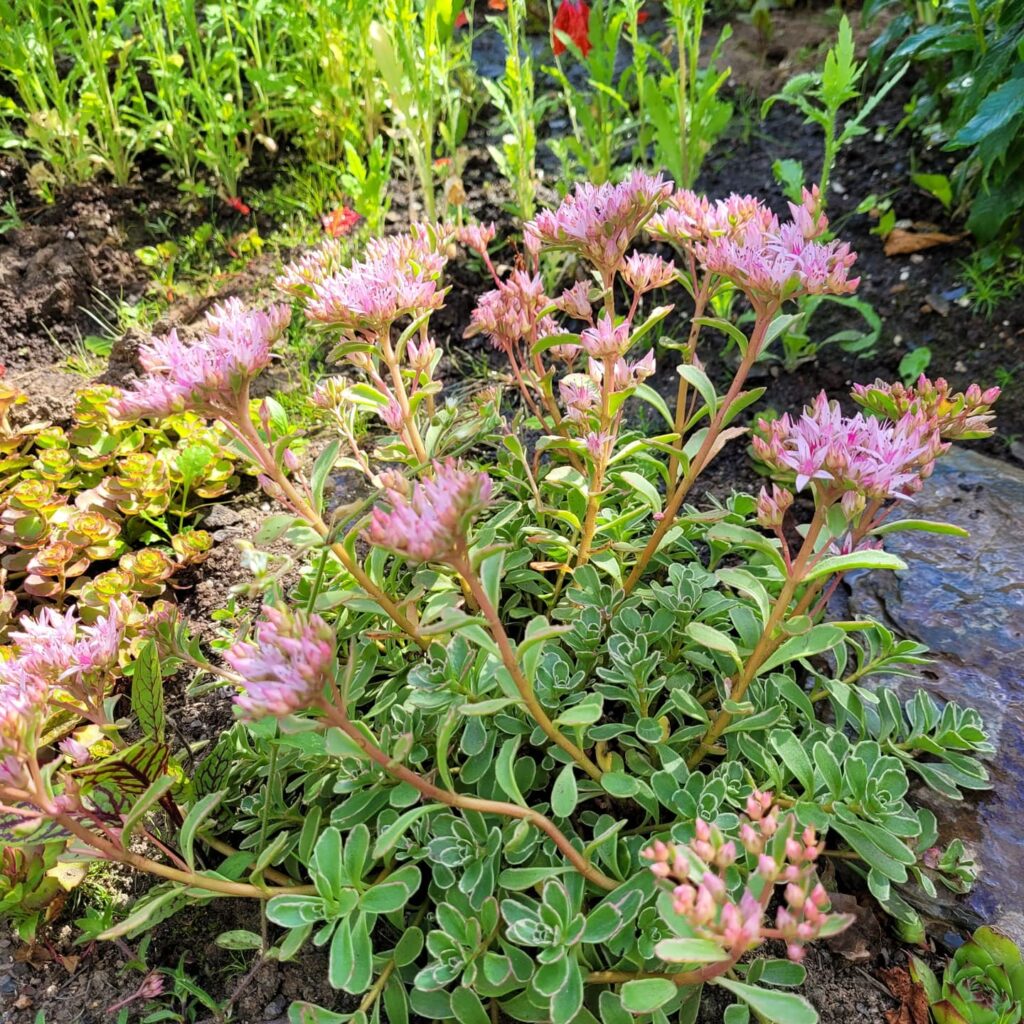
I often put pots of plants in areas that I’m working on as placeholders until I can put something in. I think spring of 2022 most of the garden will be filled in, and more will have to be divided and moved out into other parts of the yard. There should be no more perennials that need to be added. I was finally able to add 4 varieties of Stonecrop which spread very quickly and some chicks from my Hens and Chicks get mixed around for good measure.
macy helped pick a location for the Stonecrops
the flowers were a nice surprise
Stonecrops spreading out
My neighbour came over a few weeks ago and took some pieces of creeping plants for her yard so I will look forward to seeing how that turned out in the spring if I’m still in the neighbourhood.
I also decided to garden on the other side of the house this summer. There is a makeshift barrier there to keep the dogs from barking at passersby so now I’m able to plant things there without them all being dug up. And so, I just moved the Garlic bed over there and will fill that up in the next week or two. Mostly I’ve just moved some ornamental grasses, wild Geranium, and Bearded Lilies over from the main garden but could add some more delicate transplants in the spring. It’s also a great spot to hang Beans, Cukes, and Peas in hanging pots on the chain link, and some flowers along the top.
Garlic bed has a new home in a new dog-free garden zone
And if that weren’t enough, I added a little rock garden by my dog sitting seating area.
my excuse for this one is Dad sent me some Lamb’s Ears and I was out of space
I spend a lot of time in the backyard with the dogs since we got Milo last year and I can’t spend as much time in the main garden. Sometimes I sit in the shed if it’s raining or cold and play ball with the dogs from there for my morning coffee. So, I’ve sort of created this triangle of viewpoints where I can see flowers and pretty plants no matter where I am without having to enter the main garden. Mostly the backyard is full of holes the dogs have dug and muddy spots from them chasing each other around but I have this little visual oasis when I’m out with them, so I’m surrounded by beautiful things. I try to sneak into the main garden if the dogs will let me until they start misbehaving, and once they are in bed I just sit in the garden and do a bunch of nothing. Sometimes I drink beer in the garden.
Milo says, throw the ball
what? it’s raining?
can we help ma?
rainy Friday beer night outside
Mother of Thyme smells so good when you walk on it
These are a few of my favorite things…and I’m definitely dreaming about a larger rural property for more of my favorite things, peace and nature. I do what I can in my little piece of the concrete jungle.
My introduction to birding came about six (6) years ago when a Eurasian Kestrel showed up in my neighborhood. I have lived in Eastern Passage since 2007. The winter of 2015 was an extremely cold one with a lot of ice, so I was sticking close to home when I saw the news that a mega-rare bird at Hartlen Point was attracting the attention of birders from all over North America. Since it is only about 2km from my house, I took a drive down to see what all the fuss was about. The birders welcomed me into their fold, and life has never really been the same.
The pandemic has undoubtedly pushed things to the edge, and I think even the non-birders have learned firsthand how precious our wild spaces are. Being cooped up with no access to nature feels a bit like being a zoo animal in a small cage. Most backyards are not big enough, and the parks we do have are too busy for our fast-growing population. The lockdowns have been noisy, crowded, and stressful for anyone who does not have an exceptionally large property, and that is most of us.
More and more people are moving into our small communities, while our access to green spaces and coastal access is being lost to development at record rates. This is not sustainable for the long term. It is vital for our mental health to have access to nature to reconnect and recharge.
We should at least try to protect our own special little corner of the world. Surfers, birders, dog walkers, nature lovers, kayakers, farmers, fisherman, and families of many generations have enjoyed our beautiful seaside community of Eastern Passage and Cow Bay.
Perhaps it is time to think about what a Hartlen Point Nature Reserve might look like and incorporate Silver Sands Beach Park into the concept. HRM already owns about 10 acres of beach at Silver Sands, and this could be an opportunity for three (3) levels of government to work together to create something of lasting value for people and wildlife.
The entire community could rally and work together to create a unified vision that celebrates our history and culture, while preserving green space and coastal access for future generations.
If you have visited Rainbow Haven lately, you will find it is increasingly overcrowded, and down the road a bit, access to Silver Sands Beach Park has been contentious in recent months, and there seems to be little else in the community in the way of public beach access.
In early June, we found out that Hartlen Point will be the future site of increased development for a warship testing facility. Birders are afraid of losing access to the wealth of habitat bordering the golf course as they have been documenting birds at Hartlen Point for over 50 years and logged over 300 species at this location.
Cow Bay and Eastern Passage are beautifully intertwined at this coastal headland, with Silver Sands on one side, and Hartlen Point on the other, separated by no more than a small tidal channel.
Birds and other critters use the larger area as one expanse of habitat and do not recognize boundaries imagined by humankind. There are many hectares of federal land between Hartlen Point and Murray Road that are currently undeveloped, also Moses Island and other private lands that border the tidal flats. When you stand at the edge of the Hartlen Point Golf Course, you overlook the Silver Sands Beach Park.
Hartlen Point is long renowned worldwide as a prized birding destination as the headland is an attractive landing spot for migrants and rarities in spring and fall. The area incorporates coastal habitat, wetlands, forests, and grasslands.
HRM birders would like to see this area declared an IBA (important bird area). Many migrating species nest throughout Hartlen Point and Silver Sands, and many of our long-term human residents have a vast knowledge of breeding locations for both native and migrating species. Blue Heron, Northern Harrier, Great Horned Owl, Eastern Willet, Alder Flycatcher, Barn Swallow (a species at risk), and a long list of others you may not have heard of such as Common Redstarts and other visiting wood warblers raise their babies in this habitat each summer.
This ecosystem is also home to White-tailed Deer, Snowshoe Hare, Bobcat, and Eastern Coyote who are all quite well behaved with a vast expanse of green space but tend to become a problem when they lose their habitat. Their homes also need to be protected to maintain a proper balance for the good of both humans and nature to continue to coexist peacefully.
There are organizations and experts we can engage who have a wealth of knowledge and education to share about coastal protection and erosion, wetlands, and wildlife corridors and how to protect land if we unify and reach out as a community who cares. A green space with excellent coastal stewardship would be a huge success for our little seaside community.
Eastern Passage is one of the earliest settlements in HRM, with a rich history worth preserving. While Devil’s Battery and other military installations represent our more recent past, there is a strong background of farming and fishing throughout Eastern Passage and Cow Bay, which you can still feel in the soil and in the surf. We need to celebrate what makes us unique while respecting the heritage of all peoples, including our Mi’kmaq peoples who used Eastern Passage as a season home before European settlers arrived.
In the blink of an eye, it could all be gone if we do not protect it, or we can work together as a community to reclaim our natural spaces and heritage. Maybe the dream of a Hartlen Point Nature Reserve could become a reality if we stay positive and focused on the greater good. The time is now to safeguard our unique land and seascape that sets us apart from the rest of the world.
Buff-breasted Sandpiper think I was the only one to see it, during migration things are brief and fleeting.Short-billed Dowitcher…yes there is a Long-billed variety!Short-eared Owl not rare but uncommon and show up at Hartlen sporadically.Snow Geese sort of rare but show up to Hartlen most years.Snowy Owl (female) a regular visitor to Hartlen most years we get at least one and a few years ago we had seven during an irruption.
When I bought the house in 2007 this is what the seating area portion of my side garden looked like. Transforming it has been a labor of love, and during the pandemic even kept me from licking the walls somedays!
May 2020
May 2020
June 2021
June 2021
It is amazing how much colour there has been I my garden over the past month. And how much more I have planted this spring!
Last October, I pretty much finished up most of my to do list for the spring in the garden. I think we all understand all to well why I got so much gardening done ahead of schedule.
Without my garden this spring I’m not sure how I would have pulled through. Once your freedoms are restricted life is not very pleasant it would seem. So in my parcel stamp size of land, I can pretend I have some small amount of autonomy and control. About to get political, so will let this go.
My focus has shifted to flowers and seating space in my side garden, so been gradually adding perennials over the past few years, and last fall and this spring some more concrete slabs. I removed a red currant bush last year and sent it out to my friend’s yard on the South Shore to help them attract more birds to their property. Then I removed all yellow loosestrife and added more seating space. The goal was also to have lower growing plants to open things up a little more. I’m pretty pleased with the transformation.
Will add photos of my new Tulips and other blooms here shortly…off to do some gardening!
I was birding with friends from Newfoundland and New Brunswick at Hartlen Point yesterday. We found 63 bird species which is a huge list for one day. We found a flock of fall migrants right on the back of the golf course in the area that overlooks the water where Hartlen Point and Silver Sands merge.
The migrating flock included two Canada Warblers. Canada Warbler was listed as Threatened under the federal Species at Risk Act (SARA) in 2010. The SARA provides protection for individual Canada Warblers and their residences. Canada Warblers and their nests are also protected under the federal Migratory Birds Convention Act.
I snapped this photo from the golf course of Silver Sands Beach.This demonstrates how Silver Sands Beach and Harten Point are integrally connected. Hartlen Point, which is one of the most important migratory bird points in North America which people coming here from all over North America to bird each fall.
view of Silver Sands Beach from the Hartlen Point golf course – this was the view from the area where we found the flock of migratory birds including two endangered Canada Warblers on September 5, 2020
Mother Nature does not operate within survey boundaries, and to the birds and wildlife, the entire area is one and the same.As well, Rainbow Haven Beach and the Peter McNab Kuhn Conservation Area are quite close in proximity, from a coastal point of view. Even during the bird fallout of Carribean birds during Hurricane Dorian last September, the birds had a feeding loop from Hartlen Point to Rainbow Haven and Silver Sands in between. Many were able to refuel and get back home after a few days or weeks, and would have perished without those feeding grounds.
As you can imagine, Cow Bay Lake receives huge amounts of migrating shorebirds. Many of the same birds who are attracted to the Peter McNab Kuhn Conservation Area that borders Rainbow Haven Beach in the flats, such as Black-bellied Plovers. We do have protection for Shorebirds and other birds under the Migratory Bird Act that should be considered here.Anything that happens development wise has huge impact to the ecology of the entire area.
If you look at an aerial map from the perspective of a bird who has just migrated 3000km upon arrival this is all one big landing strip. Any wetlands near the coastal areas, such as the barrier ponds at Silver Sands, are precious freshwater to drink after a long trip.
In a perfect world, I would like to see the entire coastline of Silver Sands and Hartlen Point protected by a group such as the Nova Scotia Nature Trust.
Perhaps that is too lofty a goal, but there are stakeholders here who can invest in a community treasure for all to preserve something we can all be proud of for generations to come.Surfers, families, swimmers, dog walkers, birders, nature lovers, solitude seekers, and many generations from the community have enjoyed the Silver Sands Beach for many years and should continue to in peace and harmony.Environmental impacts to the area need to be taken seriously protection of wetlands and coastal areas need to be greatly tempered with the interests of developers.
Canada Warbler one of two we found on September 5th at the back of the Hartlen Point golf course where it overlooks Silver Sands Beach
The common believe when a dog adversely reacts to dogs or people or both is that he wasn’t socialized enough. Although having been raised and kept in isolation can be the foundation for this, many dogs act out not because they don’t know dogs and people, but because they do.
Fact is that when socializing is done wrong it creates a shitload of, potentially long-lasting, behavioural problems.
How to do it right? In a nutshell, exposure has to happen at the dog’s comfort level. In other words, the dog has to feel safe. Not be safe by your criteria, but feel safe. That is the only factor that matters.
Macy and Bowie on a dog date
The first few weeks before any socializing begins with a new pup or dog, she should be given time to acclimate to her new home. Not physical segregation, but allowing the dog time to find safety in a routine: “That’s where I eat, that’s where I sleep, that’s where I pee and poop, how to I fit into this new group”, and so on. No demands. We need to create the security that all basic needs are met to free the brain for learning new stuff. Behaviour happens in the brain.
Next come variations within the home. Dogs as young as 5 weeks are able to recognize and remember patterns and that is anchoring, but we don’t want a dog so stuck in a narrow rut of normalcy that she freaks out with the slightest detail change.
You want your dog to get acquainted with the idea that sometimes unfamiliar to her people enter the home. Randomly, and not every day, invite family and friends to drop in, including with their dog if that dog is socially normal. If you don’t have children, borrow some. No cookies needed here. Tell your guests to refrain from making a big fuss because what we are after is that people entering isn’t a big deal, and if we are successful we will neither get a fear response nor anticipatory excitement and over-aroused jumping and barking when the doorbell rings. Of course the canine guest could trigger some happy arousal – and that is okay. We don’t need to quell all excitement.
Also randomly, 2-3 times a week, change things up a bit within the home setting. My rule of thumb: 90% stays the same and 10% changes. For example, place something arbitrary you found in the basement in the yard, rearrange a piece of furniture in the house, borrow a large vase from a neighbour for half a day and put it in the bedroom. No coaxing. Simply place the object and let your dog be curious about it at her own speed. Exiting and entering from a different door is a change, feeding at a different spot (but not a different time – basic need food has to be predictable), and introducing new foods (carefully).
Although associative learning is more important with a young pup and newly adopted dog than operant obedience, you can introduce cues in these early days.
If I’d teach anything, it wouldn’t be sit, but leave and wait, follow and come, playfully, making it a game, using a high rate of reinforcement. Absolutely no corrections. No demands at that stage. Your pup or new dog can’t do anything wrong.
We want to build on the curiosity to changes in the home when we begin to take the dog off turf. We want our pup to be curious about the world, and ideally we want to tackle that as organically as we do with our children. Orchestrate opportunities to evoke curiosity, and then let your dog figure things out by himself. Free sniffing is a component here, but also watching with the eyes. When something catches a dog’s attention they are not certain about, they naturally halt. An older dog might simply stop moving, a pup often sits without being asked to – both are brilliant. Be brilliant too and don’t interrupt that process, not even with a treat, or you interfere with that important observational and social learning. Some owners combine the appearance of every new stimulus with a game of tug with the idea that their pooch associates new stimuli with something good. Science-wise that might make sense, but distracting is not socializing. What happens in real life is that you overshadow what’s in a dog’s surroundings, and he’ll never really notice all the normal occurrences and could still be spooked by them later. Things you thought your dog was familiarized with, seemingly trivial to you like a parked car or a garden flag, could scare the rap out of your juvenile because real learning about it never took place. Real story.
Be smart about where you take your dog. Curiosity is not possible in a pet store because we can’t allow the pup to put his teeth on all that enticing loot within reach. Being restrained from it though can be quite frustrating, and then the experience is not good. Choosing a dog friendly hardware store instead where sniffing and exploring is allowed, is better.
Being curious equals welfare, and familiarity with many things leads to readily acceptance of new things. Conversely, preventing, or worse yet correcting a pup or dog from being curious carries the risk of making him nervous of, and consequently reactive to, novelties in the future = neophobic. So don’t curb your new pup or dog’s making sense of his world even if you sometimes don’t like what he is curious about, unless, of course, it could harm him.
Curiosity is one side of the making positive life experiences coin, and choice is the other.
Choice to approach or retreat; to be approached or not, is critical during the socialization process.
Let’s chew over what social means.
Against conventional belief, it is not being everyone’s best friend or accept rude impositions from others, but to function in the environment one lives in without anxiety and frustration. My goal with my dog is that environmental stimuli are perceived as neutral, perhaps briefly paid attention to but otherwise regarded as irrelevant to their life. That is how we define being social for ourselves, do we not? A friendly nod and hello from a fellow human we encounter on a walk is nice, but we aren’t interested in being groped or having a long chat.
Regrettably, being groped without consent is exactly how socializing is still widely implemented when it comes to dogs, especially with puppies and the under 20 pounders. What unfolds is that their human at the loop end of the leash restrains, while the general public, kids and dogs included, approach hands outstretched’n’all, and little or no attention is given to whether the dog feels threatened with the too much too quickly too close.
If we want our dogs to feel comfortable around dogs and people in the future, so that we can take them with us wherever dogs are allowed to be, choice – and again that means no manipulation and coercion not even with a cookie – is key.
The dog’s space bubble must be respected, and when necessary protected, or there a considerable risk that she becomes increasingly more sensitized and reactive to increasingly more things from an increasingly larger distance. Space issues are safety issues. Always, and for all animals. We clearly get that when it comes to us.
Because choice to just walk away isn’t an option for a dog on a leash, and even when off leash there is the emotional bond and dependency to his humans, the onus is on the person to act on their dog’s behalf. In nature, too, young animals have the backup of their elders when they bravely put themselves out there. As curious as one might be, novelty in itself carries weight and can make one feel a bit queasy. Harking back to the human comparison, travelling to foreign lands, starting a new job, attending a social event where most guests are strangers, is exciting and at the same time for most of us also just a little unnerving. Or a lot.
For the owned pup and dog, that secure base to explore from and safe zone to return to is the person they are with, and you must be that consistently because relinquishing safety to another requires a huge amount of trust. The more this happens though, the more your dog will socially reference, look to you for information when he is uncertain, and follow your trained cues instead of “attacking” the problem on his own. How far a dog’s sense of self and safety extends outward depends on her nature – larger for dogs on the more cautious end of the spectrum, and her past experiences – larger if they were aversive, or perceived as such.
Learn to understand doggish, then listen to your dog. Watch her when she is presented with something new, when someone comes closer. If she needs more space, create it. A few steps are often enough. Then let her observe and process from the farther distance – if she wants to.
If a person insists to say hello to your dog or have their “friendly” dog have a sniff, demand that they don’t. Even the friendliest dog and kindest person can be felt as threatening. If your dog says no, it is no. His job is not to be an antidepressant for strangers or entertainment for their dog or kid.
If your dog is frightened by something that surprisingly popped up, or you miscalculated where you took her, get out of dodge. Change the situation for your dog.
Keeping that at the fore, take your dog to many places: walks in your ‘hood, multi-use on-leash parks, towns and cities, new to you subdivisions, boardwalks, restaurant patios, places where there are buskers and street musicians.
Switch between quieter spots and busier places, or just quieter spots if that is all your dog can handle at the moment.
Sit on a park bench with your pup by your side or on your lap and watch the world go by. Maybe share an ice cream or have a picnic.
Take your dog to places frequented by kids. Playgrounds and near schools during recess are good options because the kiddos are busy doing their own thing and chances are less that they’ll crowd your dog. Again, it is exposure only: allowing your dog to watch what young humans do: skip, run, screech, flail arms, mock fall, make snow angels.
Neither choice nor curiosity are an option in your run-of-the-mill group class.
What I unfortunately still see is the pup or newly adopted dog thrust into a room full of strangers and expected to learn right away, to sit on command and focus on the handler or else, depending which philosophy the facility follows, loses out on the treats or kibble or experiences pain and discomfort when corrected for expressions of distress.
If you sign your pup/dog up, and it is definitely not a must-do to end up with a mannered pooch, pay attention to space and the quality of the instructor.
Your instructor should be able to adjust criteria to what your dog needs and put the relationship before obedience. You should be able to increase the distance to other participants if your dog needs it, or leave early if he is overstimulated or overwhelmed. And no passing the puppy around. That can be scary for many puppies. Don’t play along.
A word about dog parks, etc. Without having kept a formal statistic, reactivity to other dogs is the major behavioural issue I am hired for. I see many more dogs barking and lunging on the leash then a decade ago, and I believe that the popularity of puppy socials, busy off leash parks, and daycare, has something to do with it. By the way, I also see many more out-of-control, rowdy in their interactions with other dogs, dogs.
Where is the problem?
Lack of choice and overstimulation!
The socializing key determinant, choice, is difficult or impossible to uphold in crowded places, and some dog parks, puppy socials, and daycare, are crowded.
In addition, not all are supervised properly and no attention is being paid to compatibility of the play groups. In such places, the self-assured pup practices being obnoxious – even if one stops playing because the game is too rough rowdy Rover simply moves on and annoys another, and the cautious and timid pup is overwhelmed by the commotion and becomes fearful when her cut-off signals are ignored.
Even for an even-keel puppy uncontrolled play with peers could be detrimental. Internationally acclaimed dog trainer and award winning author Nicole Wilde says that young dogs don’t yet have the advanced social skills to handle high arousal play, and that sentiment is shared by the famous Norwegian trainer Turid Rugaas, who says that a few minutes play with peers every-so often is okay for a pup, but in a small group that also includes an adult, or more than one. “Dogs learn how to be a proper dog from dogs who already know.” I love that phrase. So be careful who your puppy’s teachers are.
A socially normal adult is also the best reader when the energy in the room goes up and will interfere – or by watching him you know that you should. Interfere benevolently. The expressions can still look aggressive to people, but the difference is that there is no fear instilled – the pup on the receiving end is still interested in social interaction, but approaches more politely.
Benevolence even with a badass pup. Teaming an aggressive youngster up with a meaner and bigger dog to clue him in will make him fearful, more defensive, and more aggressive – if not against that dog than he’ll target a weaker one.
For a pup who is already fearful of dogs even a small group can be too much. In that case exposure has to be one dog at a time, starting with a very gentle, socially savvy adult who loves puppies. It is a lot easier for a fearful dog to read one other dog than several, and the overall energy is lower too.
But for the more self-assured and confident pooch who likes the company of other dogs every-so often daycare and dog social can work. Just not exclusively, because if off leash groups is all a dog experiences, she rehearses constantly that NOT paying attention humans whenever dogs are in the mix is a thing. Dogs become such a magnet for that dog that she’ll seek dogs out anywhere she goes. At that point it is beyond competing attention with the person she is with: Dogs are the big deal, and arousal (excitement, anticipation, frustration when on the leash and unable to act on impulse) goes up each time one is spotted, even smelled. Behaviourally that plays out with not listening to a come or leave cue, barking and lunging on the leash, and frantically pulling after scent trails.
Leash reactivity is not always because the dog feels defensive, but can also be rooted in frustration.
At least in a daycare and training facility there is some supervision; at the dog park there is none. If you go, choose the park wisely, have good enough obedience to be able to cue your dog out of a pickle, make it a normal occurrence to be on the leash at times on off leash trails (not in the smaller fenced-in spaces), and leave if there are dogs who are rowdy and inappropriate (or when yours is).
Although stipulated by bylaw in just about every municipality, not all dogs who frequent such spaces have reliable obedience, and not all owners understand when things get heated. No, dogs will not sort things out by themselves, not without a lot of distress – distress that can linger. A seasoned dog with years of great experiences can overcome the odd bad one, but an impressionable young puppy, especially a cautious-by-nature one, or newly adopted dog who knows how many bad experiences he’s had in his past, could be affected for a long time.
The dilemma is that play with dogs is part of normal social development, but a small group with compatible dogs yours likes and where all humans are on the same socializing page provides that. Studies showed that even having just one dog friend is enough to meet a dog’s social needs in that aspect (The Domestic Dog/Second Edition 288).
So it’s okay if you opt out of larger dog groups and instead look for compatible play mates. That also allows you to create opportunities for your dog to form relationships with dogs that encompass more than intense physical interactions, something Alexandra Horowitz, professor and senior research fellow and head of the Dog Cognition Lab at Barnard College, Columbia University, says is crucial for a healthy relationship between dogs. She defines play as: “an interaction between partners who are also functional in other contexts”, including on leash walks together, training together, and just hanging out. That easily happens with dogs who see each other regularly privately, meet for hikes, and who live in the same household. It can even happen in a carefully run daycare facility that has a fairly stable group of dogs that hang out with each other, rest, sniff, share toys, engage in relaxed jaw wrestling games in addition to charged-up physical romps.
Final Words
Dogs relationship with their own species can be funky. There always is the genetic factor and what happened in the first 8 weeks, but also know that social appropriateness and friendliness are not the same. Even the most diligently socialized dog, once an adult, isn’t necessarily friendly or interested in interactions with unfamiliar dogs. It was dogs our feral born Will knew. She was trapped by a humane society when she was 10 weeks old and in good physical condition, which indicates that mom-dog was able to care for her pups and others likely didn’t beat her up. In her foster homes, and with us, she only experienced benevolent and playful dogs. We took great care that her experiences with new dogs were good too, did go to off leash areas but multi-use trails, did go to dog socials but the space was large and the dogs selected. Yet, once she reached social maturity she did not tolerate any stranger dog in her space and told an offender who ignored her warning stare very sharply to “take a hike”. However, she never injured a dog or caused lingering fear in one. She was, in fact, fantastic in schooling puppies and juveniles. Always appropriate, but not friendly.
So your dog really doesn’t have to get along with every other dog to be normal. Even some puppies don’t like other dogs in their space, and if they don’t as a pup, they likely never will, no matter how hard you try to socialize. If you have such a dog, you’ll have to protect his space bubble for a lifetime, or he will have to.
With people, aside from you the only time when safe handling is required is with your veterinarian, depending on your lifestyle your dog walker or daycare staff member, and depending what breed you own, your groomer. The best chance to achieve that is not a 100 hands-a-touching in the first 3 months, but that your dog experiences that hands, yours and the hands of your chosen professionals, as gentle and safe, and that there is at least a degree of choice.
I get it: Groomers and veterinarians don’t have all day, but even there we have a movement that gears toward consent whenever possible.
It is not the more the better with a pup, and an overload of stimuli does not make up for time lost with the newly adopted older dog, but when we prioritize what the dog needs when we socialize we can prevent future problems and make things better for the dog who already is uneasy. Key is the right kind of stimuli in the right amount at the safe for the dog distance.
The more encounters the dog can check off as safe, the safer she will feel (and be) in the future. Focus on that, and that your dog gets help whenever she needs it, which includes the choice to walk away.
Doing it that way means that socializing is a slower process, and that is the crux. New puppy owners often feel under pressure to fit as many experiences as possible into the “socializing phase” we are told runs out quickly.
True, there are these first 20 or so impressionable weeks, but when experiences are perceived as aversive, again and again, the outcome can be as detrimental as making no experiences at all with the wider world.
Even if you tried, packing every possible life form your dog could encounter, every single object or situation, every surface to walk on, into that 20 week frame is impossible. For example: You get your pup in the spring or early summer, and when she is 6-8 months old she sees people bundled up in winter coats and toques.
We got Davie at the age of 16 weeks in late winter and then had an especially dry spring and summer. By the time she, for the first time, heard the sound of a car driving on a wet road she was almost a year old. She startled but quickly relaxed – because by then we had established a pattern of her freely and at her comfort level exploring new things, and we also had a relationship where she trusted me to keep her safe. Both are equally important, and both take time. Time you have. Trust me.
One more thing. Support is to provide a roadmap that makes a pup and dog feel safe, and safe again when he’s uneasy. It is a myth that by paying attention to fear that you reinforce it and make your dog more fearful in the future.
magine you are afraid of heights and find yourself stuck halfway up a ladder, frozen shut. Would your fear disappear if everyone on the ground ignored you? How would that change if someone would assure you and guide you, rung by rung, back on solid ground?
It is nonsense to believe that ignoring our dog’s fears magically makes her more confident. As long as the trigger is present, so will the emotions, and with it the expressions we don’t like. Conversely, each time we help our dog out and act on her behalf, increase distance, change the situation, or guide her into a behaviour that brings about a feeling of safety – and trained cues can be safety cues, she gains trust.
Even if there was a slight chance that a dog who receives attention when she expresses fear signals will use these in the future as an attention getting behaviour, so without the emotional aspect present, so be it. I run that risk because it is still better than not offering safety when my dog needs it. Protecting and helping is not babying. Your dog doesn’t need your pity, but for you to make decisions on his behalf. Done right, he will develop a sense of general safety when in the environment, and then he will be able to deal with an occasional stressful event without it having a lasting adverse impact.
Life is life, and distressing moments here and there are unavoidable, but if the foundation is solid, mastering little stressors together can increase the bond. The key word is together – you being on your dog’s side. Always. You must be your dog’s spokesperson and ally even if he just behaved badly. All he did was express that he felt overstimulated or overwhelmed, in any case distressed, and it’s exactly then when he needs your support more than any other time.